
Fable 5.1: I went digging a bit to find the things Anthropic didn't write in the official announcement and buried deep in the documentation.
Since the launch there's been a lot of discussion about performance, benchmarks and also quite a bit of criticism.
In my eyes the interesting things are actually the changes in the way you should work with the model, and also three things that break existing code.
The original version was a thread in Hebrew on X, published September 3, 2026.
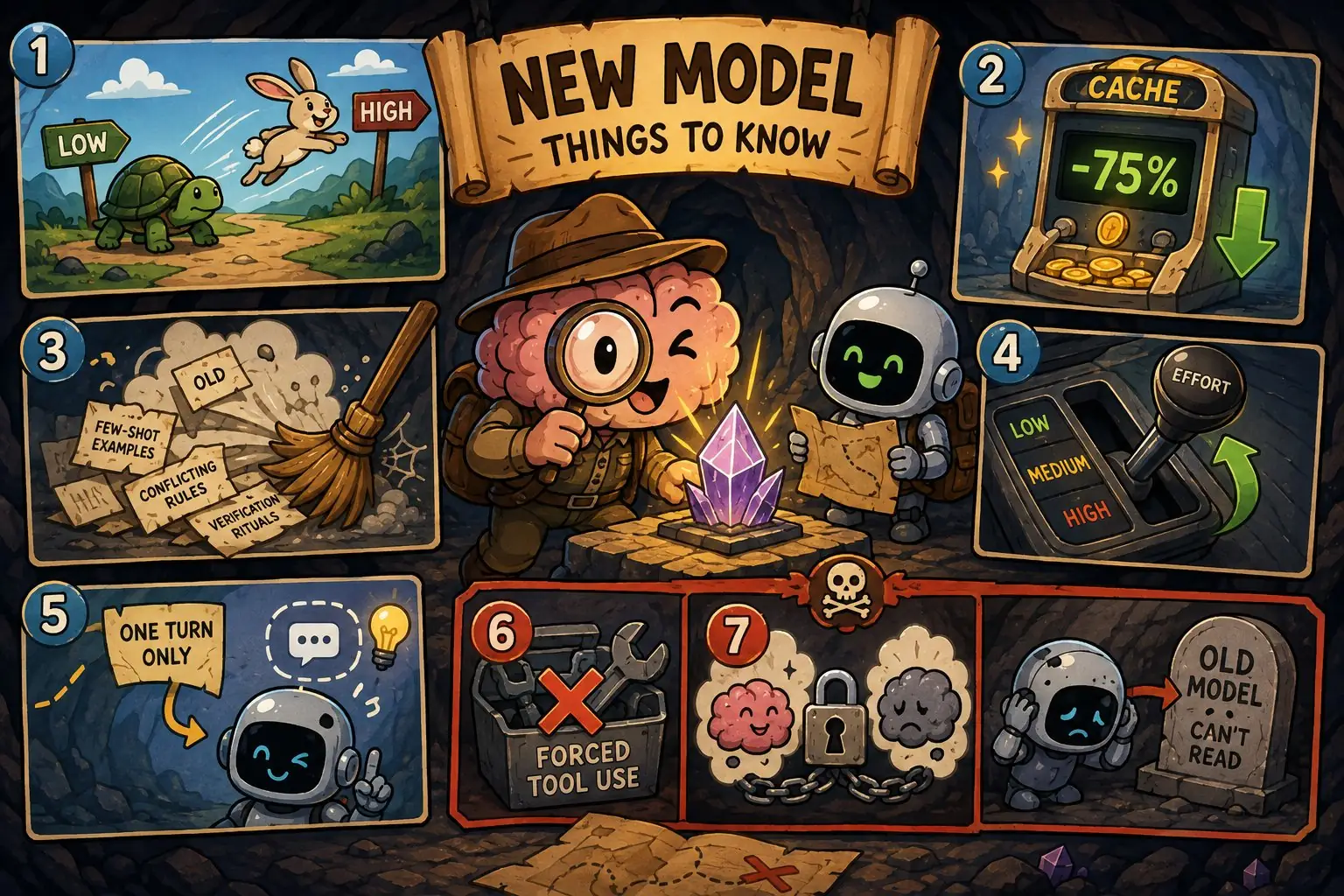
What effort level should you start Fable 5.1 on?
Start with low effort, actually.
Anthropic recommend in the docs starting from high, which is the default in the API and in Claude Code (in claude.ai and Cowork the default is medium), and then doing a sweep against evals.
I would actually work the other way around.
According to CursorBench 3.2, Fable 5.1 on low reaches 66.2% at a cost of $2.90 per task. Fable 5 on high reached 66.5% at $8.77.
Same result, a third of the price.
You can try starting with low effort and raising it only on tasks that really need it.
On low it tends to answer more from memory and go verify less, so for searching in code or documents, raise it.
In the end it's a matter of which subscription you have and how much each token costs you.
Prompt caching got a lot more worthwhile
The cache read price dropped from $1 to $0.25 per million tokens, a 75% drop.
The rest of the table didn't move: $10 input, $50 output, writes $12.50 for five minutes and $20 for an hour.
This is especially significant for agents that repeat system prompts, skills and fixed context over and over in long runs.
You can run this command in Claude Code to see the state of your cache:
/claude-api cost-optimizeTime to clean up the prompts
Anthropic recommend removing things that piled up for us over the years: verification rituals, old examples and rules that contradict each other.
Some of the prompt engineering we learned to make earlier models behave the way we wanted may now actually get in the way.
When new models come out, I open Claude on the .claude folder and ask it to do an analysis there of the skills etc. You'll be surprised at the things it finds.
Treat effort like a gear, not like a fixed setting
Until Fable 5.1, changing effort mid-session invalidated the prompt cache.
Now you send a system message with output_config.effort and change the level from the next turn without breaking the cache. It's in beta and requires a header, and works on Opus 5 and Mythos 5.1 too, not just on Fable.
In long runs this is a real difference in cost.
Don't change the system prompt for a temporary instruction
An option was added for turn-scoped system messages: you add
clear_at: "next_user_message"and the instruction lives for one turn only.
The trick is that you don't delete it afterwards but leave it in the array exactly as it is, byte for byte.
The history stays append-only, the cache stays warm, and a message that was cleared no longer costs input tokens.
Three changes that break existing code
And now for the important part.
If you build the messages array yourselves, this concerns you.
If you're on Claude Code, claude.ai or the Agent SDK, they already handle it for you.
First change: forced tool use is dead
Sending tool_choice with any or the name of a specific tool now returns 400.
Anthropic's explanation: thinking is always on, and forcing a tool call would skip it, so the model would write its thinking inside the arguments.
The solution: switch to auto and say it explicitly in the instruction, with tools defined as strict.
Second change: thinking blocks are locked to the conversation that created them
The signature of every thinking block is tied to the system prompt, to the tool list and to all the messages before it.
If you changed any of them and sent the block back, you'll get a 400 with the message that the block belongs to a different conversation.
This is enforced on accounts opened from August 31, 2026 onward. Older accounts get it only if they explicitly ask.
In practice this means all the old patterns of injecting and deleting reminders mid-conversation, or summarizing old turns in place, are simply broken.
And it's not just an error. An integration that breaks thinking on every request also resets the prompt cache on every request, and on a model whose whole economics are built on cache reads that's the most expensive mistake you can make.
Third change: older models can't read Fable 5.1's thinking
Thinking blocks only move forward. Fable 5.1 reads blocks from Opus 5, Fable 5 and what came before them, but except for Mythos 5.1 none of them reads its blocks.
If you have a fallback to Opus 4.8, the request won't fail. The API simply drops the blocks and doesn't charge for them.
But the target model plans everything from scratch without the thinking you already paid for, and that jumps in cost and latency on the first turn.
The most important tip from every launch
Don't treat moving to a new model as a change of model ID.
When models change, the optimal playbook for working with them changes too. This time the change isn't in the prompt, it's in the architecture of the agent loop itself.
What a real model switch looked like in one of my production systems, with the numbers, is in Switching LLM Models in Production.
FAQ
Does tool_choice any still work on Fable 5.1?
No. Sending tool_choice with any or the name of a specific tool now returns 400. Anthropic's explanation: thinking is always on, and forcing a tool call would skip it, so the model would write its thinking inside the arguments. The solution: switch to auto and say it explicitly in the instruction, with tools defined as strict.
Can I change effort mid-session without breaking the prompt cache?
On Fable 5.1, yes. You send a system message with output_config.effort and change the level from the next turn without breaking the cache. It's in beta and requires a header, and works on Opus 5 and Mythos 5.1 too.
What effort level should I start with on Fable 5.1?
Anthropic recommend starting from high and doing a sweep against evals. I would work the other way around: according to CursorBench 3.2, Fable 5.1 on low reaches 66.2% at $2.90 per task, and Fable 5 on high reached 66.5% at $8.77. Start low and raise it only on tasks that really need it, such as searching in code or documents.